

Meet 6 key designers in the exhibition
Edgar Brandt (1880-1960)
Edgar Brandt was an outstanding ironsmith. Born in Paris and educated at the École Nationale Professionelle de Vierzon, Brandt established his craft, setting up his own studio and exhibiting his work regularly through the annual Salons. Throughout the 1920s, he was commissioned by private hotels and houses, as well as ocean liners. Into the mid-1920s, Brandt adopted the prevailing Art Nouveau style and integrated wrought-iron and bronze furnishings with architectural elements and floral motifs, as well as more sharp angular motifs of the new decade. In 1926, he featured in the Exhibition of Modern Decorative Arts at the Metropolitan Museum of Art. Moving into the 1930s, influences of Modernism brought overlapping scrollwork and diagonal sunbeams to his portfolio. Working innovatively and dexterously, Brandt created bold and playful designs from once rigid material.
René Delavan (worked 1926-1958)
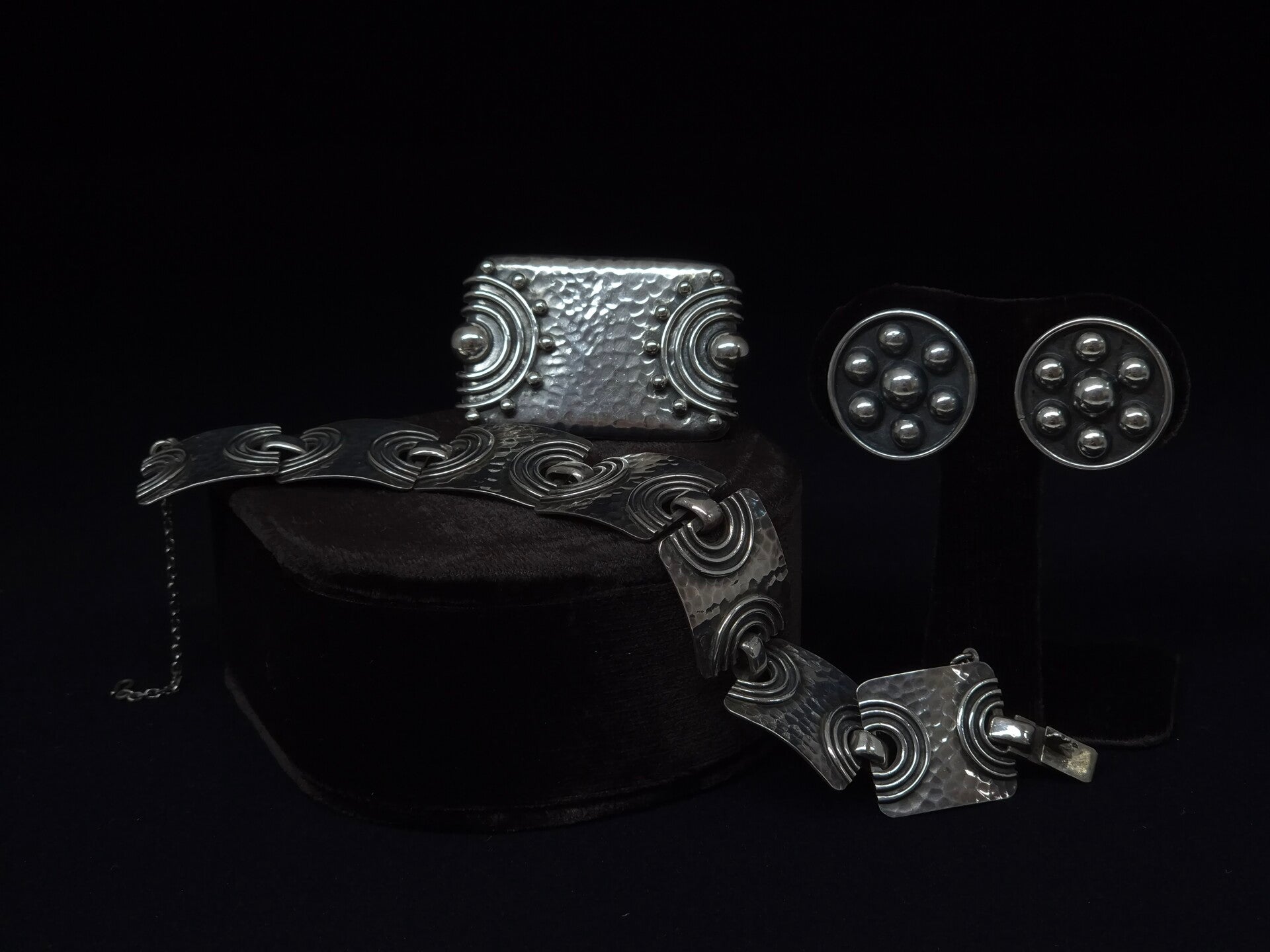
During the 1910s and 1920s the use of pewter, a tin based alloy, declined relatively due to its popularity with large manufacturers, that made it unappealing to craftsman. However, the 1920s saw a rebirth for its use, particularly with Art Deco artists such as Jean Després and Maurice Daurat, and later René Delavan. This turn in design history can be attributed to the significant influence of hammering or ‘Martelé’, a technique adopted by Delavan. He favoured it particularly for it’s ability to create the visual effects of fluting and dotting; hammering or marking an object gave it a perfect imperfection, flaws of recognition for the hands that crafted the item.
Delavan's lidded boxes displayed in this exhibition are rare finds, each displaying a unique visual character.
Jean Dunand (1877-1942)
Jean Dunand is known for his innovative mergence of traditional craftmanship and modern streamline visuals. Son to a gold smelter and student of the École des Arts Industriels in Geneva, Dunand, in his early career, became an apprentice to sculptor Jean Dampt. Mastering the materials of bronze, plaster, stone and ivory, his career branched into sculpture, then metalware and lacquer work.
Dunand grew to become a renowned craftsman of his time, developing already known techniques to retain the integrity of handmade metalware. Prioritising irregularity and the authentic nature of the materials texture and shaping, he chose to hand-hammer than to use a machine.
Dunand experimented with many materials, including repoussé copper (hammering relief from the reverse side), steel and silver. Creativity at his core, Dunand was influenced by Japanese artistry, particularly lacquer work. In 1912 he met Japanese artist Seizo Sugawara. Dunand wanted to expand the French market with Eastern art and Sugawara agreed to share his knowledge of the craft. Applying the Art Deco motif of geometric design with the technique of eggshell inlay (‘Coquille D’oeut’) within this lacquer work, he created vibrant and striking objects that can be viewed within this exhibition.
Maurice Daurat (1880-1969)
Beginning his craft in the applied arts, Daurat studied sculpting, drawing and painting at the École Germain Pilon school from 1894 to 1895. It was only later that he was introduced to metal, and started to produce bronzes, pewter pieces, and jewellery. As he grew his trade and exhibited his works at the Salon d’Automne and des Artistes Décorateurs, he adopted a technique of hammering the metal (known as ‘Martelé’) to enhance the effect of the object’s surface. Following his increasing success, he was discovered by a patron and was exhibited in Geneva, San Francisco and Barcelona, among other cities. In the years of 1925 to 1935, feeling vanity in his work after his efforts in the war, Daurat’s designs in metalwork moved towards sobriety and simplicity, only concerned with the accuracy of proportions and the subtle interplay of light on the material’s texture.
Fernand Grange (worked 1920s-1930s)
Fernand Grange was born in Clemont-Fernand and lived in Paris where he studied at the École des Arts Décoratifs. His work taking place over the 1920s and 1930s, Grange is known for his commission work in trades of goldsmithing, jewellery, and metalwork and known for his vases and dishes. His craft followed the popular design motif of the 1920s, featuring floral themes, and evolved to the geometric detailing typical of the Art Deco period, which is showcased in this exhibition.
Jean Després (1889-1980)
Jean Després was born in Souvigny-sur-Allier and came from a family of glassmakers. However, at a young age, in 1903, he was sent to Paris to learn the trade of goldsmithing and jewellery from a craftsman and family friend in the Marais district. He trained and attended evening drawing classes in the city, but was soon mobilized in 1914. He worked in the workshops of the military aviation service where he designed aircraft engines, however, continued his craft and directed a boutique in the Colisée district in Paris.
Després’s time during the war saw to him abandoning painting and transition into work with silver and pewter, particularly making jewellery, and was part of the first exhibition of the Union of Modern Artists, at the Marian Pavilion.
In 1937, Després presented jewellery inspired by aircraft engines at the l’Exposition internationale des arts et techniques (International Exhibition of Armaments and Techniques) and received a medal for his work, along with being awarded the Legion of Honour later that same year. His jewellery creations continued their success, being featured in the “Ten Centuries of French Jewellery” exhibition at the Louvre in 1962.
His discovery of the forms of machinery inspired geometric aspects in his designs that can be seen in this exhibition, providing a repetitive and rigid composition opposed to the flourished floral design trends others favoured. Arguably, the most prevalent theme of his work was his replication of the shapes of bolts, bars and nuts, and his ability to create cohesive and visually captivating pieces to be adorned by.
Address
10 Piccadilly Arcade,
St James’s,
London,
SW1Y 6NH
Opening hours
Monday 11:00 - 19:00
Tuesday 11:00 - 19:00
Wednesday 11:00 - 19.00
Thursday 11:00 - 19:00
Friday 11:00 - 17:00
Saturday 11:00 - 19:00
Sunday 12:00 - 19:00
Social media